
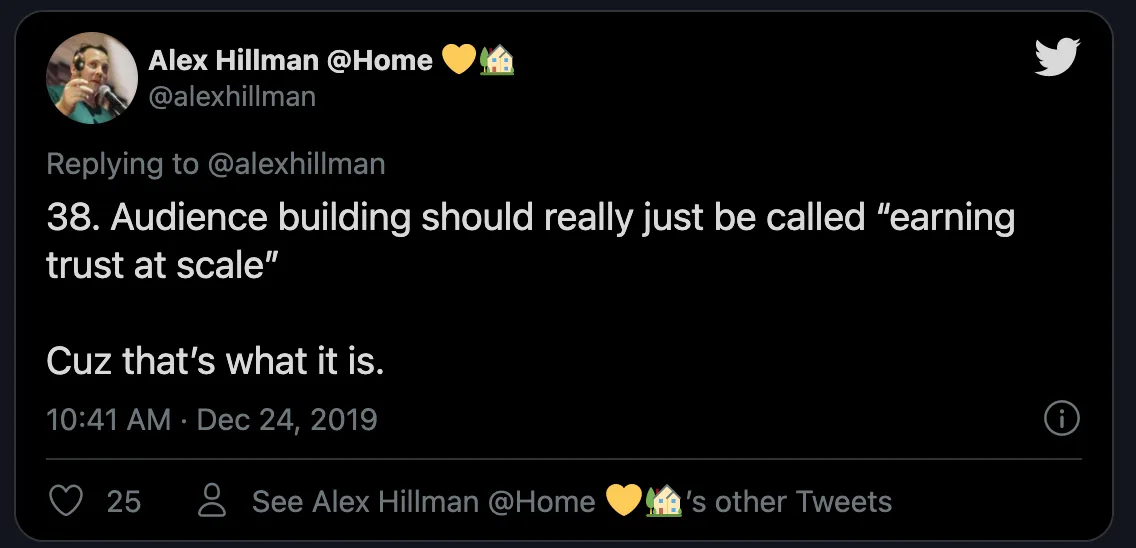
Marketing Is Earning Trust at Scale


The word "marketing" holds an enormous amount of connotations in each of our minds.
Some positive, but most (in my experience) are negative.
Why is this?
Well, when we experience marketing we don't like, we tend to remember it. When we experience marketing we do like (or more aptly: don't mind), we don't remember it.
There's all sorts of science behind this. This article on negative bias posits that evolutionary roots have us focus on the negative to keep us out of danger and help us survive. It also mentions that neuroscientific evidence has shown that there is greater neural processing in the brain in response to negative stimuli. I think we can all agree that it's just easier to be a critic than it is to be a creator as well. Human beings are amazing at pointing out flaws.
But I have a simpler explanation. Good marketing (the type you don't mind and that may actually be enjoyable) takes hard work. Bad marketing (the type you remember forever and complain online about) takes little to no work.
There's a distinct relationship between the amount of work you put in and the efficacy of your marketing.
Alex Hillman of Stacking The Bricks, Indyhall, and The Tiny MBA (which is derivative of this tweet thread), said:
Earning trust — the privilege of asking for the sale — is hard work.
To complete that thought, here's the tweet right before that one:
Earning trust at scale. That's real marketing. Good marketing. Dare I say helpful marketing.
Let's unpack what this means by honing in on "earning trust."
Trust is the belief in the reliability, truth, or ability of someone or something.
"Does this person know what they're talking about?"
"Will this product really do what it's said to do?"
"Will this thing solve my problem?"
Every time a product is bought, a contract is signed, or a link is clicked, people are demonstrating trust. Both personal and business relationships are continuous exchanges.
And exchanges require trust: I give you this and you give me that in return.
Trust can't be bought. It has to be earned. It's hard-won and easily lost. It's a brand's most valuable asset. It must be protected at all costs.
But the magic is that once you have it, you have it. Having someone's trust means they'll listen. They'll buy. They'll refer. And they'll come back tomorrow.
And then we have "at scale."
With the internet, we're in an age of infinite leverage. Media creation is completely democratized. Anyone can spin up a Twitter account, a blog, a podcast, or a YouTube channel. You can connect with anyone around the world in an instant with your media.
Not only is media creation democratized, media distribution is also democratized. Not only can anyone buy ads, but anyone's content can rank on the first page of Google's search engine results. Anyone's tweet can go viral. Etcetera, you get the idea.
Look at the root of the word leverage. Levers are force multipliers.
Without leverage, you're confined to a linear relationship between effort and impact. One connection at a time, one relationship at a time, one sale at a time. With leverage, you can access a nonlinear relationship between effort and impact. Many connections at once, many relationships at once, many sales at once.
Herein lies the difference between marketing and sales: Marketing is sales, but asynchronously and at scale.
- Sales: 1:1
- Marketing: 1:many
Leverage also gives way to compounding effects.
Compounding allows you to reap huge rewards from small, seemingly insignificant actions.
Improving your website conversion rate from 1% to 3% is not a 2% improvement, it's a 300% improvement. Write an article every week and the traffic may be small at the beginning, but over time a rising tide lifts all boats and the culmination of your traffic can be remarkable.
We can definitely spend time worrying about/building the tsunami, but it's the drip, drip, drip that will change everything in the long run. — Seth Godin
Small choices + consistency + time = significant results.
There's a profound line from Ernest Hemingway’s The Sun Also Rises that can be applied to both success and failure:
“How did you go bankrupt?” Bill asked.
“Two ways,” Mike said. “Gradually, then suddenly.”
"Gradually, then suddenly" perfectly sums up what happens when you put in the hard work of earning trust at scale every day and then one day you look up and the sales are flooding in, your open rate puts a smile on your face, and you might even be kinda-internet-famous.
Marketing is earning trust at scale.
The question is, who's trust are you trying to earn? How will you earn it? Which levers are you going to focus on pulling?

Without the customer insights gained by following Corey’s advice, my business would not be where it is today.


Corey is truly a swiss-army knife of SaaS product-led growth.


Corey really knows his stuff... He’s the first person I turn to for help.


Suggested articles
How to Launch on Product Hunt (Playbook to #1 of the Day)
What is a Good LTV:CAC Ratio for SaaS?
The ORB Framework: A New Way To Think About Marketing Strategy
Swipe the best SaaS homepages
Grab our hand-picked collection of homepages proven to convert.